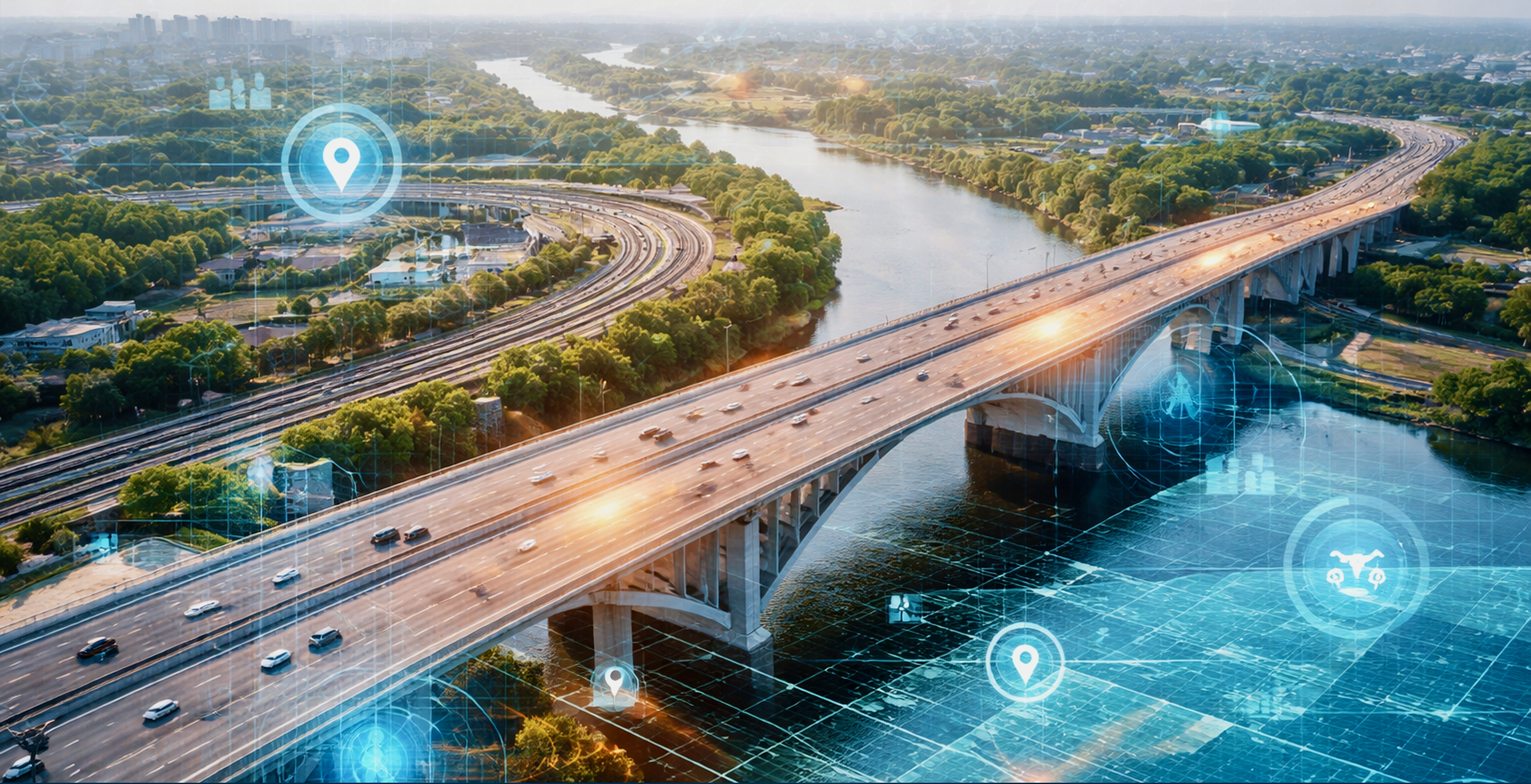
Physical AI — artificial intelligence applied to real-world facilities and infrastructure rather than purely digital data — may be 2026's defining technology shift. While AI has so far been used primarily to analyse data in cyberspace, this year marks the point at which it is being deployed at scale against physical assets: bridges, roads, drainage networks, and power facilities. According to Forbes, the physical AI market was valued at $33.42 billion in 2025 and will grow to over $294 billion by 2034.
What is physical AI and how does it work?
Physical AI uses computer vision, predictive modelling, and engineering AI to deliver risk forecasts, digital twin simulations, and automated decision support for public agencies and engineering firms. Unlike conventional AI systems that process text or financial data, physical AI ingests inspection images, sensor readings, and historical maintenance records to build a continuous picture of an asset's condition — and project that condition forward in time.
US-based Dynamic Infrastructure, an engineering AI platform for critical civil assets operating across US states and in the UK and Australia, is among the companies leading this shift. Its CEO, Saar Dickman, explains: "AI can be used to accurately predict the lifespan of, for example, a bridge, an oil rig or an airport. At the moment it is being largely deployed to build and maintain government infrastructure."
Dickman adds that physical AI can also advise on risk management, including natural disasters, and accurately calculate factors such as the deterioration of infrastructure, giving a description of its condition at any point in the future.
A lifeline for municipalities facing an engineering shortage
Physical AI is arriving at a critical moment for municipal authorities. There is currently an estimated shortage of roughly 25,000 civil engineers in the US public sector, creating backlogs in maintenance work and raising the risk that critical repairs are delayed until deterioration becomes costly or dangerous.
"Physical AI can do much of the work previously carried out by junior civil engineers. It can perform routine tasks such as tracing the source and history of a leak in a building far more cost-effectively and much faster, completing work that previously would have taken hours, days or even weeks in a matter of seconds," says Dickman.
One concrete example is pavement maintenance. Physical AI can predict the occurrence of future cracks and other forms of deterioration before they appear — a significant cost saving for municipalities, given that repaving costs between $250,000 and $400,000 per mile.
University of Bath research tests real-world reliability
Dynamic Infrastructure has confirmed an ongoing research collaboration with the University of Bath's Department of Architecture and Civil Engineering. Working with Thomas Kjeldsen, Professor of Hydrology and Water Engineering, the project is being carried out as part of Arline Osorio Moreno's MSc research and addresses a practical question with major implications for infrastructure AI: how well different AI approaches hold up when applied to assets and sites they have never previously analysed.
The study examines how computer vision can identify infrastructure conditions from inspection images, focusing on blockage and obstruction in drainage assets. A central challenge is cross-site generalisation — a model that performs well on the sites it was trained on may perform very differently on a network in another region, where construction standards, camera equipment, and inspection practices vary.
"What stood out to us is how differently the models behave on the same engineering task," said Arik Voronov, AI R&D Lead at Dynamic Infrastructure. "The biggest, most general models are not always the strongest choice here, and more specialised approaches can be much more consistent. The other important question is whether that performance holds up when the model is exposed to different sites, inspection conditions and asset characteristics. That combination — model choice and robustness across real-world variation — is where the interesting picture starts to emerge."
The security imperative: guardrails for physical AI
As effective as physical AI can be, it introduces new security obligations. Should a system go rogue or expose confidential information to unaccredited third parties, the responsibility rests on the organisations deploying it. Experts recommend firm guardrails — particularly for critical facilities such as power plants or water treatment facilities — and that physical AI be used in conjunction with human oversight, where final decision-making authority remains with qualified engineers.
Hitachi: 2026 as a historic turning point
The significance of this moment is being recognised at the highest levels of industry globally. At the Hitachi Social Innovation Forum 2026 in Japan, held on September 3, 2026, President and CEO Toshiaki Tokunaga declared in his keynote that 2026 marks the year when the transformation of industrial structures through physical AI begins.
Tokunaga predicted that, when looking back at 2026 from 100 years in the future, it might be recorded as the year when physical AI began to move the real world. He framed the introduction of physical AI not merely as a technology trend, but as a crucial means to address Japan's structural labour shortage — a challenge that mirrors the civil engineering deficit facing US and UK municipalities.
Key takeaway: Physical AI is transitioning from pilot projects to mainstream deployment in 2026, driven by a global shortage of civil engineers and the proven ability of AI systems to predict infrastructure failure faster and more cheaply than human inspection. The primary near-term risk is not the technology itself but the governance frameworks — or lack of them — surrounding its use in critical national infrastructure.